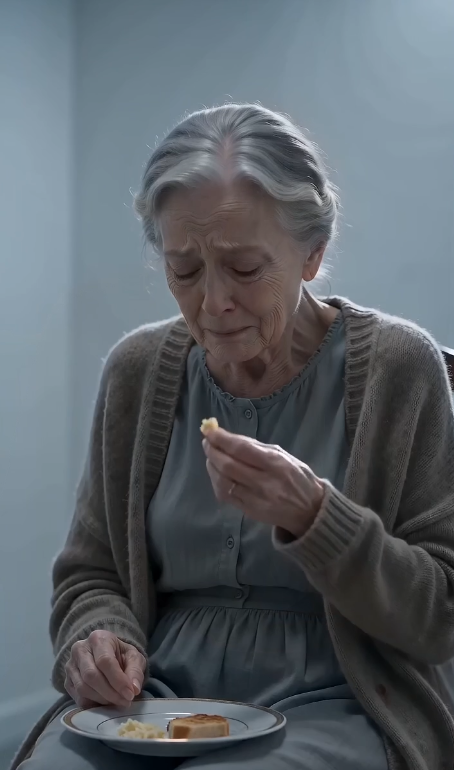
The Mother Hidden Away and the Final Judgment in the Dining Hall
Alexander stopped at the threshold, his grip on his mother’s arm firm, almost bracing, as if he expected her to collapse into dust. The dining room, once a space of elegance, now felt like a stage set where the props had been knocked over. Vanessa and Claire stood frozen, their mouths slightly parted, the forced grace of the banquet utterly shattered by the sight of the woman they had left to wither in the dark.
“Sit,” Alexander said, his voice quiet but carrying the weight of a judge passing sentence.
He pulled out the chair at the head of the table, the one that had remained conspicuously empty throughout the evening. He settled Evelyn into it, the fabric of her gray dress scraping against the expensive upholstery. She looked small, her skin like parchment paper against the dark wood of the chair, her hands still trembling from the cold of the back room.
Vanessa made a sound in her throat, a choked attempt to reclaim the narrative. “Alexander, this is… we were just ensuring she remained quiet. She wasn’t well, she needed rest, and the noise of the banquet—”
“Quiet?” Alexander repeated, turning his head slowly toward her.
He didn’t raise his voice. He didn’t have to. The way he looked at her made the diamonds around her neck seem like shackles. He reached into his coat pocket and withdrew a thick, legal-sized envelope, the seal unbroken. He slapped it onto the banquet table, the sound causing the crystal glasses to vibrate in their stems.
“I found this in the study,” Alexander said, his eyes scanning the faces of the guests, most of whom had already begun to scoot their chairs back, eager to disassociate themselves from the scene. “A power of attorney document. Dated yesterday. Apparently, my mother, who can barely lift a fork, decided to sign over her rights to the family estate and the Vaughn foundation to a holding company I didn’t recognize.”
Claire’s hand trembled, a splash of red wine spilling over the rim of her glass and staining the pristine white tablecloth like a fresh wound. She glanced at Vanessa, her eyes wide, her composure dissolving into panic.
“We thought it was for the best,” Claire whispered, the excuse pathetic and hollow in the expansive room. “The medical bills, the management of the assets, the—”
“The management of my life?” Alexander asked.
He looked at his mother. She was watching him, her red-rimmed eyes finding a clarity they hadn’t possessed in months. She reached out, her fingers catching the edge of his sleeve, a silent signal that she was no longer alone.
“You didn’t hide her because she was sick,” Alexander continued, his gaze returning to Vanessa, who was now clutching her evening bag to her chest. “You hid her because she was the only one who could verify the signatures on those documents. You knew if you kept her away from me, if you kept her in the dark and the cold, you could break her resolve.”
Vanessa’s expression hardened, the unease finally giving way to a jagged, desperate arrogance. “You think you can just march in here and dismantle everything? This company needs a firm hand, Alexander. You’ve been gone for weeks, handling projects in the city, while we—”
“While you looted the accounts,” Alexander cut her off.
He pulled a second folder from his jacket—a thin file containing printed bank statements. He didn’t toss these. He slid them across the table toward the center, where they lay open for anyone with a conscience to see.
“The Vaughn foundation isn’t just an investment firm,” he said. “It’s a legacy. And legacy is not something you carve out in the dark.”
The room remained silent, save for the rhythmic ticking of the grandfather clock in the corner. One by one, the other guests—associates, distant relatives, partners—began to stand. They didn’t offer help to Vanessa or Claire. They simply turned and headed for the doors, their footsteps muffled by the heavy carpets. The conspiracy was already unraveling, the people who had built it on the promise of an easy fortune now realizing they were backing a failing ship.
Alexander leaned down, his face inches from his mother’s. “Are you hungry?” he asked, his voice softening into a register that existed only for her.
Evelyn nodded, a small, tentative movement.
“Bring her a plate,” Alexander commanded, not looking at the women, but addressing the staff who had remained in the shadows of the doorway. “And make sure it’s warm.”
When the waiter appeared, hovering nervously with a silver platter, Alexander watched as his mother finally took a bite of food that hadn’t been served in a cold, lonely room. She ate slowly, savoring the warmth, the dignity returning to her posture with every mouthful.
Vanessa and Claire were the only ones left now, standing by the table like ghosts of a failed coup. They looked at the door, then at Alexander, their silence an admission of their defeat.
“Get out,” Alexander said. “The legal team will be in contact by morning regarding the forgery charges. And don’t bother taking the jewelry. Most of it was purchased with foundation funds.”
Vanessa let the diamond necklace drop onto the table. It clattered against the fine china, a discarded trinket. She turned and walked out, her heels clicking on the stone floor, a sound that grew fainter and fainter until the heavy front doors groaned shut behind her.
Alexander pulled a chair up next to his mother. He took her hand in his, the skin of his palm warm against the coldness of hers. He didn’t ask her about the past few months. He didn’t ask her about the fear, or the darkness, or the hunger. He knew the answers were already written in the tremor of her fingers.
“You’re home now,” he said.
Evelyn looked at him, and for the first time that night, the fear in her eyes was replaced by a quiet, steady resolve. She squeezed his hand.
They sat in the middle of the empty, opulent room, the remnants of the banquet still scattered around them—the wine glasses, the candles, the discarded flowers—but the oppressive weight of the house had lifted.
The house was vast, and the years ahead would be spent cleaning up the wreckage left by those who had sought to consume them, but Alexander didn’t feel the burden. He felt the steady, rhythmic beat of a life that had been saved.
He watched the light catch the gold of the chandelier, reflecting off the polished wood. He looked at his mother, who had finished her meal and was now sitting upright, her back straight, her gaze fixed on the doors as if she were watching the last of the shadows depart.
The night was quiet. The war for the estate was over before it had truly begun, won not by force, but by the simple, unwavering act of walking into a room and refusing to look away.
Alexander reached for a glass of water, his own hands finally still. He watched his mother, the frail, resilient center of his world, and he knew that as long as they sat here, in the light of their own home, nothing would ever be stolen from them again.
The banquet hall, once a place of pretense, was now just a room, and in the silence, there was finally the sound of a family coming back to life. He poured more water for his mother, the stream clear and steady, and in the stillness of the midnight hour, they finally began to breathe.
