The Silent Witness and the Truth Behind the Grand Entrance
Daniel stood motionless, the handle of his suitcase digging into his palm. He looked from Vanessa’s frantic, pale face to the small, shivering heap of his mother on the marble floor. The mop, heavy and damp, lay discarded like a piece of evidence. He didn’t say a word. He let the silence stretch until it felt heavy enough to crush them all.
He walked past Vanessa as if she were a ghost, his shoes clicking rhythmically across the marble. When he reached his mother, he knelt, his knees hitting the stone with a dull, sharp crack. He didn’t pull her into his arms immediately; he touched her hand first, his fingers gentle against her paper-thin skin. She flinched, a sharp, instinctive pull-back that hurt more than any slap could have.
“Mom,” he said, his voice barely a whisper. “I’m here.”
Margaret looked up, her eyes wide, glassy with a terror that made Daniel’s heart stop. She couldn’t find her voice, only a soft, ragged wheeze that tore through the quiet hallway. Rosa, still kneeling beside her, stayed perfectly still, her hands hovering near Margaret’s waist, ready to move but waiting for Daniel’s permission.
“Daniel, you don’t understand,” Vanessa said, her voice rising in a sharp, desperate pitch from behind him. “She was acting out, she was trying to—she got confused and started throwing things, I was just trying to clean it up, I had to stop her—”
Daniel stood up, his movement fluid and controlled, the kind of stillness that usually preceded a storm. He walked over to the spot where Vanessa had been standing. There, tucked under the edge of a console table, was a sheet of paper. He picked it up. It was a power of attorney document, the ink still fresh, with a jagged, shaky signature at the bottom that looked nothing like his mother’s elegant, cursive hand.
He looked at the date at the top of the form. It was today’s date.
“You were cleaning up,” Daniel said, his back to her. “With a mop?”
“She was drooling, she was making a mess!” Vanessa shouted, her facade finally stripping away to reveal the raw, ugly desperation beneath. “She’s a burden, Daniel! You haven’t been here to see it, you haven’t been here to deal with the constant, unending drain of her existence.”
Daniel turned, and the look in his eyes made Vanessa take a stumbling step backward. He didn’t shout; he didn’t even raise his voice. He simply held the paper out, letting it flutter slightly in the draft from the open door.
“This isn’t about her health, Vanessa,” he said. “This is about the estate.”
He looked at Rosa, whose eyes were fixed on the floor, her expression carefully neutral. He remembered the quiet, steady way she had moved through the house in the brief moments he had been home over the last few months. He hadn’t paid enough attention.
“Rosa,” Daniel said. “What has been happening here when I’m gone?”
Rosa stood up, her uniform slightly rumpled but her posture dignified. She reached into the pocket of her apron and produced a small, leather-bound notebook. She didn’t look at Vanessa, who was now clutching her red dress as if it were a shield.
“She hasn’t been eating in the dining room for three weeks, sir,” Rosa said, her voice steady and clear. “Mrs. Carter was kept in her room, and when I tried to bring her food, I was told to leave it on the tray outside the door. She wasn’t allowed to see the sunlight. The medication she takes for her heart—the dosages were changed.”
Daniel felt the floor beneath him tilt. He moved toward his wife, the distance between them shrinking until he could smell the expensive, cloying scent of her perfume—a scent he used to associate with luxury, now tainted by the reality of the cold, starving woman on the floor.
“How much?” he asked.
Vanessa’s lips parted, but no sound came out.
“How much did you sell, Vanessa? What did you take?”
She looked at the front door, then at the staircase, as if searching for an exit that didn’t exist. “I did it for us,” she whispered, her eyes brimming with a performance of tears that fell completely flat. “We have debts, Daniel. The investments in the city—they went south, and I had to cover the losses before the auditors came.”
Daniel shook his head, a slow, grim movement. He reached into his pocket, pulled out his phone, and dialed a number. He didn’t look at her as he spoke into the receiver, giving the address, giving the time, giving a brief, clinical description of the situation.
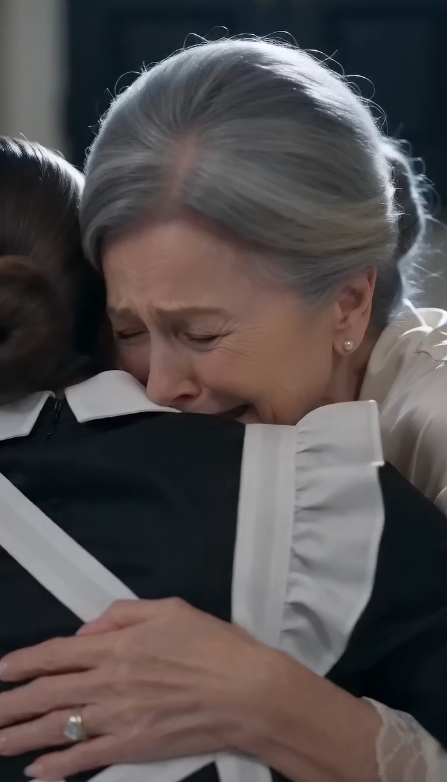
When he hung up, the house felt empty, stripped of the veneer of grandeur. Vanessa had begun to sob, a loud, artificial sound that echoed in the vaulted ceiling, but nobody was listening. Rosa had already moved to the kitchen to fetch a glass of water for Margaret, and Daniel was busy wrapping his mother in his suit jacket, shielding her from the draft of the open door.
The police sirens arrived a few minutes later, their blue and red lights painting the foyer in shifting, unnatural colors. Vanessa didn’t fight when they arrived. She watched them with a hollow, distant look, as if she were waiting for someone to wake her up from a dream that had turned into a nightmare.
As they led her out, the high-slit of her red dress catching on the edge of the marble, she didn’t look back at the mansion. She didn’t look at Daniel. She looked only at the floor, the place where she had lost everything.
The front door closed, the lock clicking shut with a final, definitive sound. The house was quiet again.
Daniel sat on the floor with his mother, his arm wrapped around her shoulders. She had stopped shivering, the warmth of the jacket and the presence of her son finally anchoring her back to the world. She leaned her head against him, her breathing slow and steady.
“It’s over,” he said, his voice barely audible in the cavernous room.
Margaret didn’t speak, but she squeezed his hand—a firm, deliberate pressure that told him more than words ever could. She was still here.
Daniel looked up at the chandelier, the crystals catching the light of the police cruisers outside. The house was still beautiful, still opulent, still rich, but the coldness had been exorcised. It was just a house again, a place where they could begin to learn how to exist without the weight of secrets.
He thought about the notebook Rosa had held, the record of the small, daily cruelties that had built up into a mountain. He realized that the greatest tragedy wasn’t the theft of the estate or the collapse of his marriage; it was the fact that he had been standing in the doorway all along, refusing to look at the truth because he liked the way the life looked from the outside.
He looked at Rosa, who stood by the sideboard, waiting to see if he needed anything else. He stood up, helping his mother to her feet, and nodded at the maid.
“Thank you, Rosa,” he said.
She nodded back, her face softening for the first time that night.
They walked toward the kitchen, the marble floor beneath their feet steady and solid. For the first time in years, the path forward felt clear. He wasn’t worried about the bank accounts or the auditors or the scandal that would inevitably consume the front pages of the morning paper.
He was worried about the tea, and the blanket, and the quiet. He was worried about the small, simple acts of care that had been absent for so long.
As they entered the kitchen, the light was warm and amber, a stark contrast to the sterile, blue-lit foyer. He pulled out a chair, tucked a blanket around his mother’s legs, and sat down across from her. He looked into her eyes, seeing the tired, worn lines of a woman who had survived the unthinkable, and for the first time, he felt a flicker of something he hadn’t experienced in years.
He felt at peace. The house was quiet, the storm had passed, and finally, they were home.
