The Mother Who Held the Keys to Their Ruin
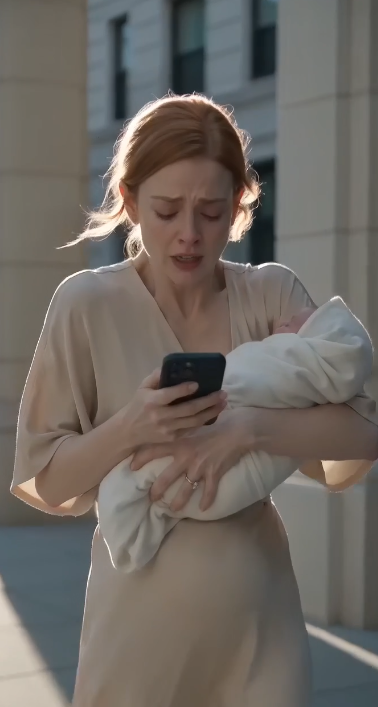
The cold asphalt bit into the soles of Claire’s feet, but she didn’t slow down. Behind her, the rhythmic slap of polished dress shoes against the pavement signaled that Adrian was closing the distance. He didn’t care about the neighbors or the cameras. He only cared about the leverage he was losing with every step she took toward the gate.
“Stop, Claire,” he hissed, his voice stripping away the thin veneer of gentility he wore in public. “Do not be a fool. You have nowhere to go, and the baby doesn’t need to be dragged through this.”
She didn’t stop. She adjusted the blanket around the newborn’s head, her heart hammering against her ribs like a trapped bird. The fear was still there, sharp and acidic, but it was being pushed aside by a cold, clarity of purpose. She wasn’t running away anymore. She was walking toward the help that was already on its way.
A heavy, low-frequency hum vibrated through the ground, growing into the distinct, aggressive roar of high-performance engines. Adrian paused, his hand reaching out to grab her arm, but he faltered. Two matte-black SUVs swerved into the driveway, blocking the path of his luxury vehicle, their tires screeching as they came to a dead stop.
They weren’t police cruisers. They were something else—faster, darker, and entirely focused on the target. The doors opened in a synchronized blur of motion, and four men in charcoal tactical gear emerged, moving with a fluid, lethal professionalism. They didn’t draw weapons, but they didn’t have to; their positioning was absolute.
Adrian’s hand dropped from Claire’s arm, his face losing all of its color. He looked at the SUVs, then at the men, and finally at Claire. “What is this?” he stammered, the command gone from his voice. “Who are they?”
Claire turned, finally facing him. She didn’t look like the panicked woman he had bullied in the hallway just minutes ago. She looked like a daughter who knew exactly who her father was. “They’re the people you should have asked about before you decided to starve me out,” she said.
The lead security officer, a man with a scarred jaw and steady eyes, stepped toward them. He didn’t look at Adrian. He bowed his head slightly toward Claire. “Ms. Whitmore. Your father is on the line. He wants to know if you’re safe.”
“I’m safe,” she said, her voice steady. “But I’m done.”
Inside the black SUV, Eleanor and Victoria had stopped their silent judging. They were pressed against the tinted glass, their eyes wide and frantic. One of the security men tapped on their window, and when Eleanor rolled it down, he didn’t offer a greeting. He handed her a thin, cream-colored document.
“Your mortgage, your corporate accounts, and your personal lines of credit have been transferred,” the guard said, his voice flat. “The Whitmore estate is under new management as of four minutes ago. You have thirty minutes to vacate the property.”
The silence that followed was brittle, broken only by the wind. Victoria let out a choked sound, clutching her chest as if she had been struck. The power they had wielded over Claire—the threats about her finances, the demands for her to “behave”—was entirely based on the illusion that they held the purse strings. They had been spending her father’s money the whole time, living in his houses, playing at being royalty while he had been tightening the noose.
Adrian looked at his mother, then at the men standing between him and his wife. He looked older, suddenly, the sharp lines of his face sagging with the weight of his own hubris. He tried to speak, to offer some kind of justification, but the words died in his throat when the lead officer stepped into his space.
“The company belongs to the Hayes family,” the guard said, looking Adrian up and down with open distaste. “You were just the caretakers. And you were fired.”
Claire watched the realization land. It wasn’t a physical blow, but it looked like one. Adrian’s knees seemed to buckle, the arrogance that had defined his relationship with her vanishing into the dust. He looked like a man who had suddenly realized he had been walking on a floor made of thin ice.
She didn’t feel triumph. She didn’t feel the need to gloat. She simply felt a profound, exhausting relief. She had spent months playing the part of the fragile, dependent wife because she had been told she had no other choice. She had been trapped in a narrative written by people who valued assets over human beings. Now, the page had been ripped out.
“Come on,” Claire said to the lead guard. “Let’s go.”
She turned and walked past the SUVs. Adrian didn’t move to stop her. He stood there, watching his life dissolve on the concrete. Behind her, she heard the sound of the in-laws arguing, their voices rising in a shrill, desperate chorus as the reality of their homelessness set in. They weren’t powerful anymore. They were just guests who had overstayed their welcome.
The SUV doors opened for her. She climbed inside, the interior cool and smelling of leather and safety. As the vehicle pulled away, she looked back one last time. The mansion sat on the hill, majestic and cold, but it no longer looked like a prison. It looked like a museum for a way of life that hadn’t been hers to begin with.
The drive was silent. She watched the city pass, the lights blinking like distant stars in the gathering dusk. She felt the newborn shift against her, a soft, warm weight that finally belonged only to her. She looked at her phone, the screen still lit with the caller ID of her father. She didn’t answer yet; she just held it, letting the quiet wash over her.
They reached the private terminal at the airport, a sprawling, empty space where a jet waited on the tarmac. Her father was standing at the bottom of the stairs, his coat open, his face weathered but kind. He didn’t run to her, and he didn’t demand an explanation. He just held out his arms.
She stepped out of the car, her bare feet touching the pavement. She walked to him, and he took her in his arms, holding her the way he had when she was a little girl. She let the tears fall then—not from fear, but from the simple, overwhelming knowledge that she didn’t have to carry the burden anymore.
“I have you,” he whispered into her hair. “You never have to go back there.”
She nodded, her forehead resting against his shoulder. The jet engine began to spool up, a deep, powerful sound that signaled the start of everything. She looked back toward the city, toward the place where the shadows had held her captive, and saw nothing but the horizon.
She was going home. Not to a house, or an estate, or a legacy, but to a life that she could finally, honestly, call her own. As the plane taxied onto the runway, the lights of the city began to shrink, turning into tiny, insignificant specks of color in the dark. She closed her eyes, the rhythm of the newborn’s heart beating against her own, and for the first time in her adult life, she slept without dreaming of locks and chains. The past was behind her, the sun would rise on a different world, and the daughter who walked onto that plane was not the same one who had walked away from the car. She was whole.
