The Secret Chamber Behind the Flames and the Future We Reclaimed
The darkness inside was suffocating, a heavy, velvet void that tasted of sulfur and scorched paint. Heat radiated from the walls in waves, shimmering through the gloom, yet it was a modulated, low-grade temperature that defied the roar of the machinery. Sophia clutched Ethan’s jacket, her fingernails digging into the thick wool, her heart hammering against his chest like a trapped bird.
She could feel the cold metal of the floor beneath them, a stark contrast to the stifling air. Ethan’s breathing was sharp, rhythmic, the sound of a man who was counting seconds in his head. He didn’t search the walls blindly. He moved with a terrifying, calculated precision, his hands tracing the rivets of the furnace lining until they found a faint, irregular seam near the base.
“The cooling intake,” he whispered, his voice barely audible over the hum of the conveyor system outside. “It’s not a furnace, Sophia. It’s a waste-sanitization prototype. They designed it to destroy data, not biomass. That’s why we’re not burning yet.”
He kicked at the seam. His boot hit the metal with a resonant, hollow thud. He didn’t curse or falter; he just shifted his weight, pressing his shoulder against a specific protruding bolt. The wall gave a sickening screech of rusted metal being forced against its will, and a sliver of cool, clean air whistled into the chamber.
Sophia didn’t ask how he knew. She didn’t ask why he had this level of intimate knowledge of a place that was supposed to be a tomb. She only knew that the pressure in the chamber was shifting, the heavy heat being drawn out by the intake, and that Ethan was the only thing standing between her and the void. He wedged his fingers into the seam, pulling until the tendons in his neck corded.
The metal groaned, a high, piercing sound of tortured steel, before the panel swung inward. They scrambled through the opening, tumbling into a narrow, dimly lit service corridor. It smelled of industrial grease and damp concrete, the antithesis of the sterile, high-end medical facility they had left behind. Sophia collapsed against the wall, her lungs burning as she sucked in the relatively cool air.
Ethan was already moving, his eyes tracking the overhead wiring. He wasn’t looking for a way out; he was looking for the relay box. He ripped the cover off a junction panel, his fingers blurring as he bypassed the lock-out protocols. He wasn’t just fixing a machine; he was dismantling a sequence.
“You’ve been here before,” Sophia said, her voice raw, her hands trembling as she pulled her patient gown tight around her frame.
Ethan paused. He didn’t turn around. He stayed focused on the wiring, his shoulders rigid. “I helped design the prototype for this facility six years ago. It was supposed to be for secure medical waste destruction. I never saw the blueprints for the final build. If I had known what Margaret was going to use it for…”
He left the sentence unfinished. He didn’t have to. The shame in his voice was a heavier weight than the metal panels he was manipulating. He wasn’t just a man who had stumbled upon a murder; he was a man who had helped build the architecture of her potential execution.
“She’s just the manager,” Ethan continued, his voice hardening. “She’s not the one funding this. She’s too sloppy. There’s a consultant, a man named Vane. He’s the one who ordered the cleanup.”
“Cleanup?” Sophia asked. The word sent a shiver down her spine.
“That’s what they called you in the files, Sophia. You weren’t a patient. You were a ‘residual variable’.”
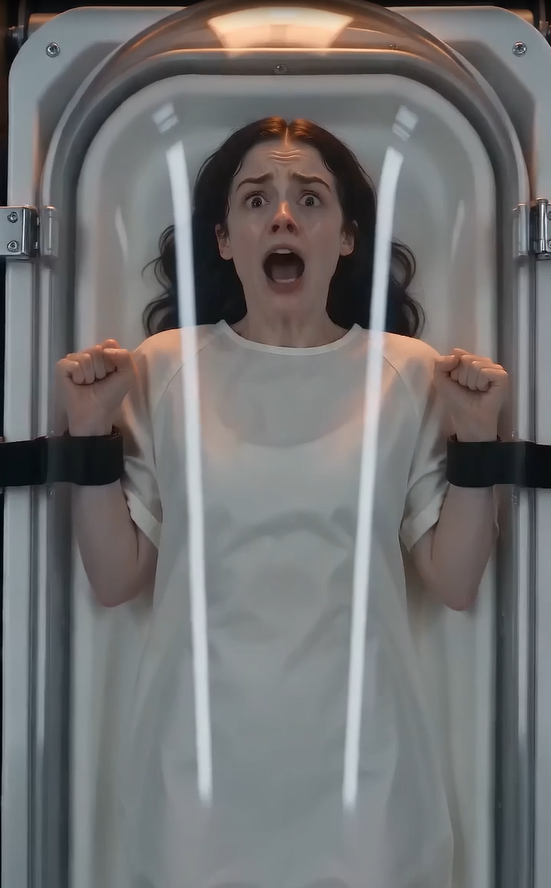
The corridor light flickered and died, replaced by the faint, rhythmic strobe of the facility’s emergency grid. Ethan turned then, his face pale and etched with a jagged intensity. He took her hands, his touch grounding, firm, and undeniably real. The confusion that had clouded her vision since she woke up in the glass box began to clear. She realized now that the target hadn’t been her life, but the information she had been trying to leak to the press.
They crept through the service corridor, moving with the silent, practiced grace of fugitives. Every sound—a distant pipe rattle, the low thrum of the ventilation—sent a spike of adrenaline through Sophia’s system. They reached the freight elevator, a massive cage used for transport, and Ethan forced the doors open.
“We go up,” he said. “The main exit is controlled by the security desk. We go to the roof.”
The elevator groaned as it ascended, the mechanical ascent slow and agonizingly loud. Sophia kept her eyes on the floor numbers as they crawled past—Level B2, B1, Lobby. When the doors finally slid open to the roof, the world felt impossibly large. The night air hit them with the force of a physical blow, clean and cold, smelling of rain and asphalt.
The facility’s rooftop was a vast expanse of gray concrete, illuminated by the hum of cooling fans and the distant glow of the city lights. They didn’t run. They walked toward the edge, looking for a way down, when a shadow detached itself from the stairwell door.
It was Margaret. She stood there, not with a control panel, but with a silenced pistol held with the steady, practiced grip of someone who had done this before. Her face was no longer cold; it was twisted into a mask of frantic, desperate fury. She looked past them, toward the city, as if expecting someone else to appear.
“You weren’t supposed to get out,” she said, her voice shaking. “Vane will kill me. He said it was done.”
Ethan stepped in front of Sophia. He didn’t raise his hands. He just looked at Margaret, his gaze pitying. “He’s not coming, Margaret. You’re the loose end now. Why do you think the security feed hasn’t engaged? Why do you think the perimeter is silent?”
Margaret’s hand wavered. She looked at the door, then back at the dark expanse of the roof. “He promised…”
“He promised you a payout,” Ethan said, taking a step toward her. “He promised you a life. All he gave you was a cleaning bill.”
The sound of rotors shattered the quiet of the night. A black helicopter swung into view, its searchlight scouring the roof, not for them, but for the movement of the person hiding by the stairwell. Margaret didn’t wait. She turned and fired at the sky, a futile gesture that only served to draw the light toward her.
The helicopter’s spotlight pinned her against the concrete. She didn’t drop the gun. She didn’t surrender. She just stood there, blinded, a solitary, broken figure against the vast, indifferent expanse of the roof. Sophia watched as the tactical team swarmed the landing pad, the reality of the situation sinking in.
She was safe. The weight of the coffin, the furnace, and the fear began to lift. She looked at Ethan, who was watching the arrests with a hollow, haunted expression. He hadn’t just saved her; he had burned down the architecture of his own guilt.
As the paramedics led them toward the transport, Sophia looked back at the furnace chimney, now silent, now just a stack of steel against the stars. She wasn’t a variable anymore. She was a woman who had walked through the fire and emerged, not as the ash they had wanted, but as the witness they had failed to bury. The road ahead was uncertain, a labyrinth of trials and questions, but as she felt the cool night air on her skin, she knew it was a road she would walk on her own terms. She breathed in, a long, deep, steady breath, and for the first time, she felt the life within her reach out to greet the dawn.
