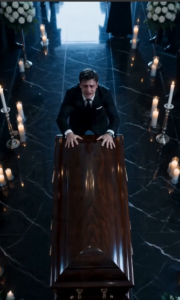
The air in the funeral home felt thick, like heavy velvet pressing against the lungs. The sobs of the mourners were nothing more than a dissonant hum compared to the screeching alarm bells ringing in Julian’s ears. He looked at Maria—the woman who had married his father less than a year ago—and saw not a mourning widow, but a frantic creature cornered in a cage of her own making.
“A disease?” Julian’s voice was a low, dangerous vibration. “My father was healthy enough to play golf three days ago. What ‘disease’ moves that fast, Maria? Or is it that he’s not as ‘at rest’ as you want everyone to believe?”
Maria’s grip on his shoulders was bruising, her fingernails digging into his skin. “I am trying to save you!” she hissed, her face inches from his, her perfectly manicured mask sliding off to reveal the jagged panic underneath. “The doctors, the coroner—it was all documented! If you open that lid, the infection will release. You will kill everyone in this room!”
Julian didn’t blink. He looked past her, at the mahogany casket resting on the dais. It was beautiful, expensive, and utterly wrong. He remembered his father’s last words to him—not a farewell, but a frantic warning about Maria’s obsession with the family estate and her sudden, clandestine meetings with a lawyer who specialized in probate law.
“Step aside,” Julian commanded.
“No!” Maria lunged for the casket, her composure snapping entirely. She shoved Julian, a desperate, irrational strength fueling her. “You have no idea what you’re doing!”
But Julian was younger, stronger, and driven by a primal, burning certainty. He sidestepped her, grabbed the lid of the casket, and slammed his shoulder against the brass latch. The room went deathly silent; even the staged sobbing halted.
With a sharp crack that sounded like a gunshot in the hushed hall, the seal broke.
The heavy lid fell back, hitting the floor with a dull thud.
Julian’s breath caught in his throat. His father lay inside, his clothes disheveled, his skin pale and slick with sweat. But it was his eyes that stole the air from the room—they were wide, darting, and filled with a terror so profound it made Julian’s heart stop. A small, ragged piece of cloth was jammed into his mouth, and his fingernails were torn and bloody—scratched into the velvet lining of the casket from the inside.
He wasn’t dead. He had been paralyzed, drugged to mimic the stillness of death, and then consigned to the earth to be suffocated in the dark—a living tomb for a man whose only crime was having a fortune Maria wanted to inherit.
As the room erupted into a cacophony of screams and shock, Julian pulled the cloth from his father’s mouth. The older man gasped, a wet, rattling sound that was the most beautiful thing Julian had ever heard.
Maria didn’t run. She stood frozen, the black lace of her dress suddenly looking like a funeral shroud for her own ambitions. She looked at the guests—the police chief, the family lawyers, the city’s elite—and realized that the coffin hadn’t buried a secret; it had incubated a confession.
The “widow” was swiftly taken down by the very security she had hired to keep the “disease” away. As the paramedics rushed to the dais, Julian knelt by his father, his hand trembling as he brushed the hair from his forehead.
The funeral was meant to be the end of his father’s life. Instead, it became the moment Maria’s entire world burned to the ground. She had built a trap, but she had failed to account for one thing: a son’s gut instinct is a predator that never stops hunting until the truth is found.
